
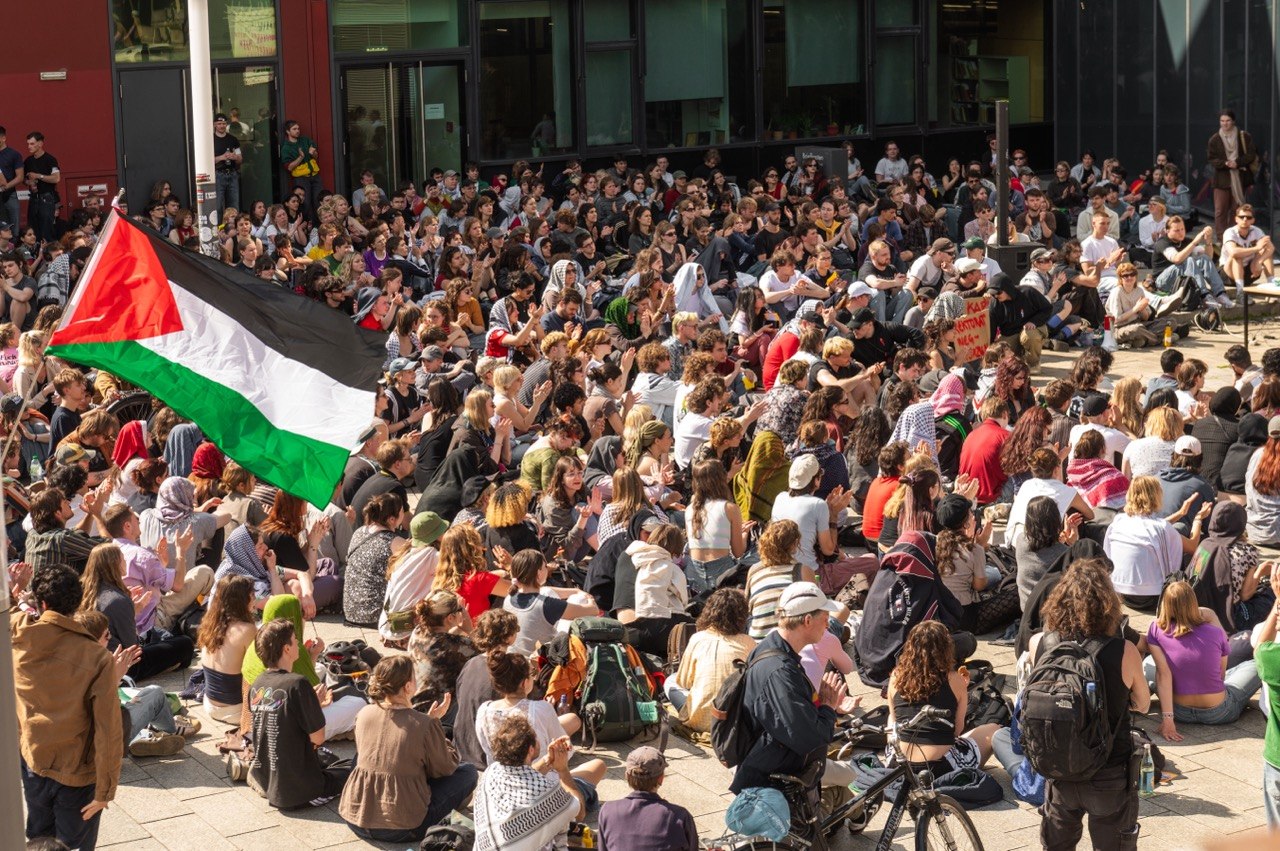
Nearly 700 students at Leipzig University voted almost unanimously in favour of six demands, including a call to cut all ties with Israeli universities and publicly condemn the war against the Palestinians in Gaza. In conversation with Jule Stein, Orlando, spokesperson for Students for Palestine Leipzig, explains the rationale behind the resolution, discusses academic boycott campaigns, describes what the group sees as attempts by the university administration to obstruct the vote, and outlines the movement’s next steps.
etos.media: Leipzig University’s General Student Assembly voted in favour of a resolution calling for an academic boycott of Israeli institutions. Before we get into the details, can you tell us about the significance of this vote?
Orlando: The nearly 700 attending students almost unanimously adopted six demands. Among them is the call to acknowledge and publicly condemn the genocidal war on Gaza, including the scholasticide. The students also decided that Leipzig University must cut all ties with Israeli universities and institutions. This is the first time a German-speaking university has held a General Student Assembly on an academic boycott.
etos.media: What was the process behind formulating those demands? Were there any points you wanted to include in the resolution but ultimately decided against? [O1]
Orlando: In drafting the demands, we looked at other movements in Germany and around the world, because we are by no means the only students or university staff advocating for an academic boycott. We also drew specifically on the 2004 call by Palestinian civil society, PACBI, which outlines demands and guidelines for meaningful academic boycotts. Building on this extensive work, we formulated a set of proposed demands for the General Student Assembly, including the termination of all ties with Israeli universities.
It was also important for us to include the demand that Leipzig University publicly condemn the genocide in Gaza. Our university has failed to acknowledge this genocide and the scholasticide. Instead, it has repressed groups and students who have become active in solidarity with Palestine. The one cooperation agreement Leipzig University had with a Palestinian university expired last year, and when that university — Birzeit University — was raided by the Israeli military in January, Leipzig University once again remained silent. This has nothing to do with academic neutrality, as you cannot be neutral in a situation of genocide or military occupation.
For us, it became clear that Leipzig University was not living up to its own commitment to “human rights for all.” As students, we therefore wanted to make our voices heard. Every demand could be discussed during the General Student Assembly, and every student present had the opportunity to propose additional demands or amendments. In this way, we made clear that the students of Leipzig who participated in the assembly collectively stand behind these demands.
etos.media: Why do you think academic boycott movements are important with regard to the rights of Palestinians?
Orlando: The boycott movement against South Africa historically demonstrated that organised boycotts can be an effective tool in combating apartheid systems. That is why PACBI (the Palestinian Campaign for the Academic and Cultural Boycott of Israel) has been fighting for such a boycott since 2004. As Students for Palestine Leipzig, we published a report in October 2025 that not only documents the ties between Leipzig University and Israeli universities but also extensively demonstrates how these universities function as a vital part of the Israeli state apparatus. We therefore believe that cooperating with these universities is problematic in itself, because the very act of cooperation legitimises and normalises these institutions.
All five Israeli partner universities of Leipzig University are an essential component of the Israeli military complex. They develop weapons, surveillance systems, and recruit students on their campus in order to make them join military units. Students who end up joining the units that carry out the genocide in Gaza get academic credits for that.
Moreover, Israeli universities produce knowledge that helps the state design and maintain the apartheid system. They also contribute to the production of narratives and ideological paradigms that legitimise Israeli policies of ethnic cleansing and present them as acceptable to the international community. One relevant example of this phenomenon is archaeology projects. These projects often seek to support the myth that Palestinians don’t exist and that Palestine was empty before the settlers came. That’s how Israel, for instance, justified ethnically cleansing the Palestinian village Susiya. Leipzig University participates in one such archaeology project together with Ben Gurion University.
Additionally, all Israeli universities stand on occupied land. They were built on the ruins of Palestinian villages that were destroyed during the Nakba and were partially founded in order to speed up the colonisation of Palestine. Leipzig University maintains student exchange programs with four Israeli universities and is therefore actively supporting the ongoing occupation of Palestine.
etos.media: What were the greatest difficulties and challenges to get to this vote?
Orlando: Our biggest challenge was certainly the repression we faced from the rectorate of Leipzig University. We are consistently treated differently from other groups. It starts with smaller things, such as being threatened with fines for unauthorised flyering or having university security present during our lectures to monitor us. To our knowledge, this is the first time in the history of the university that this has happened to any group to such an extent.
The situation further escalated over the last couple of weeks. One major issue was that the university blocked the distribution of the invitation email to all students, which would have invited everyone to the Vollversammlung. According to the law — the Sächsisches Hochschulgesetz — this is illegal.
The university also unilaterally cancelled our room for the Vollversammlung just one day before it was scheduled to take place. We had requested the room on 17 February and received confirmation on 20 March. The university had plenty of time to raise any concerns but decided to cancel the booking at the last minute. It is difficult not to interpret this as an attempt to silence, sabotage, and repress us.
The rectorate also tried to delegitimise our student assembly, claiming that it does not represent the students and is not in accordance with our constitution. Contrary to these claims, the student assembly is perfectly legal and compliant with the constitution of the student council, as the body’s own management confirmed in its statement. The rectorate should know this, since it signed that constitution itself. We manually collected close to 1,300 signatures in order to convene the Vollversammlung. The assembly is therefore not only legitimate; it is also a clear reflection of the students‘ demand and need for discussion on this topic, as evidenced by the high number of signatures and participants in the General Student Assembly. By targeting student self-governance, the rectorate is illegally undermining its own democratic institutions — not based on legitimate concerns, but out of a blatant disregard for student concerns and a fundamental refusal to engage with valid, well-founded criticism.
etos.media: In your opinion, is it true that Leipzig is a centre of “Antideutsche,” and what kind of interactions have you had with them?
Orlando: Leipzig certainly was a centre of the so-called Antideutsche. They definitely had a strong presence right after the start of the genocide in Gaza, as they would at times disrupt our events, going so far as to physically attack us. The hegemony of those people has long since been broken in Leipzig, as the Vollversammlung itself demonstrates. The Vollversammlung was attended by around 800 people, including close to 700 voting students, while the counter-protest consisted of nine Zionists well past their thirties who played techno songs celebrating the genocide.
Among those protesting against us was Juliane Nagel (PdL), which demonstrates that while the Antideutsche have no social base and are rapidly dying out, they still occupy some institutional positions. We are happy to be part of the movement that has transformed Leipzig from a centre of Zionists into a centre of anti-imperialists.
etos.media: What will be the next steps after the vote?
Orlando: The student council will publish the resolutions in an appropriate manner. Given that the resolutions of the Vollversammlung now represent the demands of Leipzig University’s collective student body, it will become progressively harder for the university to publicly ignore or disregard the issue of academic complicity.
However, for Leipzig University to cut all ties with Israeli institutions, a fundamental shift in Germany’s political landscape is required — one that begins with steadily growing public dissent across all spheres of society. On campus, we will continue to organise, advocate, and build support for an academic boycott among both students and university staff. The Vollversammlung is only one of many ways to rally support and channel our discontent through the university’s official democratic mechanisms.
etos.media: How can people in Leipzig and people in Germany support the next steps?
Orlando: We are not alone in our struggle against academic complicity. If you study in Germany, chances are high that there is an academic boycott campaign happening at your university right now. Not only in Leipzig, but across Germany, groups have published or are currently in the process of writing reports that lay bare their universities’ complicity. Every single person can make a difference in these campaigns. We call on everybody to join these groups and help keep the discourse on campus alive. This means not only informing yourself by reading the reports, but also sharing that knowledge and engaging in discussions with friends, fellow students, and university staff.
As for us, we will be holding an open plenary on 10 June at 7 p.m. in front of the Ziegenledersaal on Leipzig University’s main campus.


 Wird geladen ...