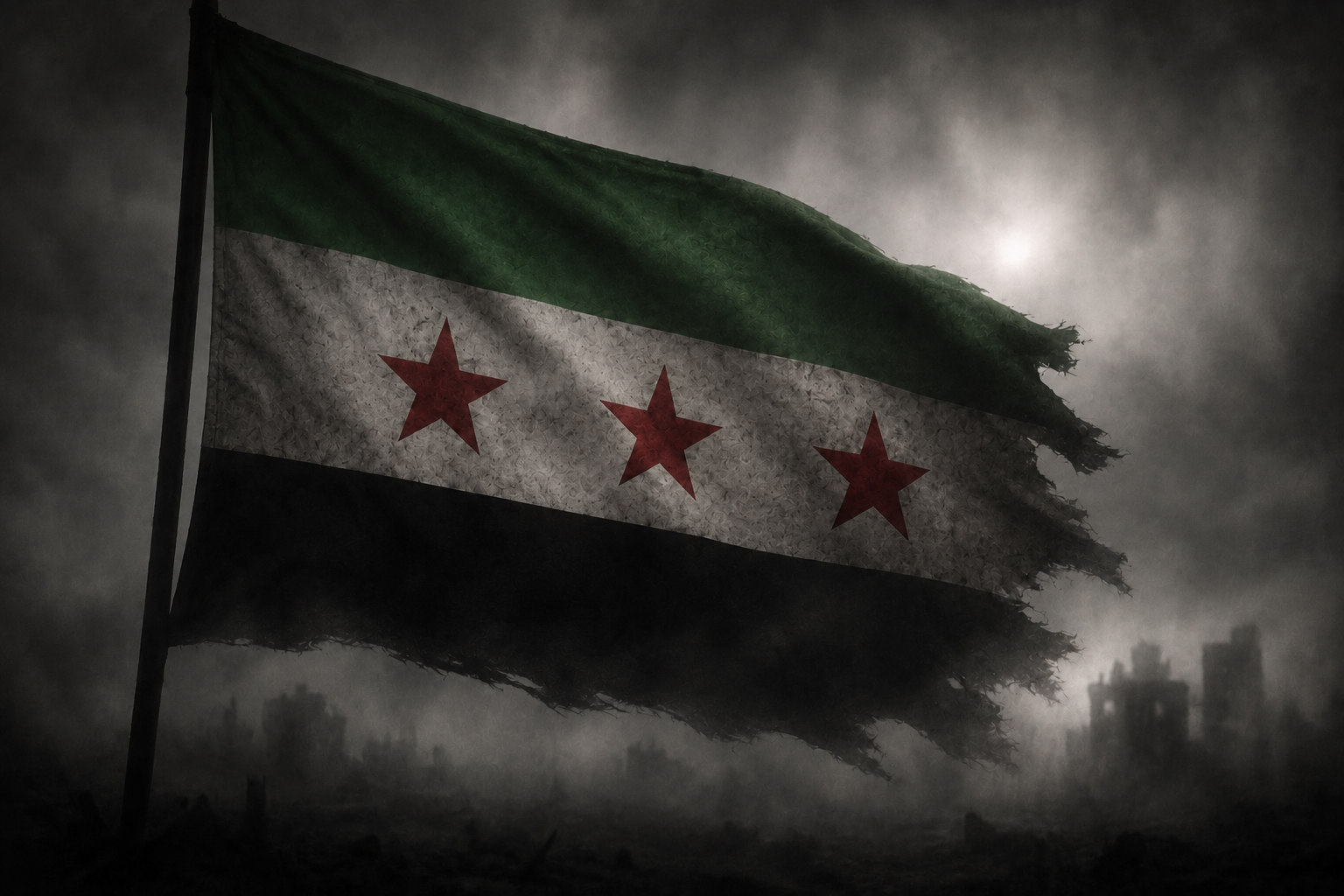
Syria’s transitional authorities increasingly appear to be governing as though their rule were permanent. Under Ahmed al-Sharaa, power has become increasingly centralised, while questions over human rights, transitional justice, national sovereignty and the influence of former HTS figures remain unresolved. What does this mean for Syria’s unity and political future? An analysis by Nour Kanj.
english|deutsch
As with previous analyses on Syria, this analysis examines the country’s evolving political trajectory through the conduct of its current group in power, the extremist ideological principles it upholds, and whether it is capable of serving the nation as a whole, and to what extent. This analysis offers a critical assessment of Syria’s current transitional authorities, examining their record in the areas of governance, civil rights, national sovereignty, transitional justice, and institutional development.
Temporary and Transitional Authority
One of the most fundamental realities deliberately overlooked by the HTS-led authorities governing Syria is that they constitute nothing more than a transitional administration. They are neither a permanent government nor one that has acquired genuine political legitimacy. Despite this, their conduct increasingly reflects that of a long-term ruling authority rather than a temporary administration entrusted with guiding the country through a transitional period.
Recognising and accepting the temporary nature of their mandate should be regarded as an absolute priority. As long as Ahmed al-Sharaa and his political allies continue to act as though their rule is permanent, they risk further undermining Syria’s prospects for a genuine political transition. In doing so, the country continues to lose valuable time that could instead be devoted to establishing a legitimate transitional process capable of laying the foundations for a stable and representative political order.
This tendency is also reflected in the public statements of the current leadership. Its members consistently avoid describing themselves in clear and direct terms as merely “temporary” or “transitional” authorities. Instead, their rhetoric and political behaviour frequently suggest that they assume they will remain in power indefinitely. Consequently, they have increasingly devoted their efforts to matters that extend well beyond the responsibilities of a transitional administration.
Examples of such initiatives are numerous. They include the introduction of a new state emblem, as well as discussions concerning negotiations and the possibility of a final peace agreement with Israel—an issue that carries profound constitutional, political, and national implications, particularly in light of Israel’s continued military operations in Syrian territory and its longstanding occupation of the Golan Heights. Decisions of this magnitude should not be made by a temporary transitional authority, whose primary responsibility ought to be to facilitate Syria’s political transition rather than to make irreversible decisions.
This disregard for the administration’s temporary status is also reflected in the institutional reforms introduced under Ahmed al-Sharaa. Rather than limiting itself to establishing the basic mechanisms necessary to oversee a transitional period, the current leadership has sought to reshape the structure of the Syrian state through the creation of new political institutions. Among these is a parliament whose powers remain highly limited and whose composition is, to a significant extent, determined through presidential appointments. As a result, critics argue that the institution functions less as an independent legislative body than as a mechanism for providing political legitimacy to decisions already taken by the transitional president and his administration.
More broadly, the state reforms undertaken by the current authorities display a political structure that is heavily centred around former members of HTS. Many of these individuals have transitioned from military or insurgent roles into senior political office while retaining considerable influence over the country’s institutions. Critics argue that this transformation has often involved little more than a change in public presentation, with military attire replaced by formal political dress, without a corresponding renewal of the governing elite.
Examples frequently cited include President Ahmed al-Sharaa, formerly known by his nom de guerre Abu Mohammad al-Jolani and the leader of HTS; Foreign Minister Asaad al-Shaibani, formerly known as Abu Aisha and also an HTS combatant; and Defence Minister Murhaf Abu Qasra, who also held a senior position within HTS before assuming government office. These figures represent only a few former HTS officials who now occupy key positions within the Syrian state apparatus.
A further point of criticism concerns the professional background of many members of the current leadership. Opponents argue that a significant proportion of those occupying senior governmental positions possess extensive experience in armed Islamist movements but comparatively limited experience in civil administration, public governance, or state institutions. Despite these concerns, the current authorities increasingly present themselves—and are increasingly treated by many western leaders—as a legitimate long-term government rather than as a temporary administration established to oversee Syria’s political transition.
Civil and Women’s Rights
The transitional Syrian government has so far appeared to be deliberately managing its approach in order to avoid the kinds of obvious mistakes many observers initially expected it to make, particularly the immediate implementation of broad, Islamist policies concerning human rights—and especially women’s rights. Rather than introducing sweeping restrictions at the outset, the authorities have instead adopted a more gradual approach, implementing incremental measures that collectively advance the same objectives over time.
Examples of this strategy have emerged across the country since HTS assumed power. Instead of enacting comprehensive nationwide legislation on issues such as dress codes, the authorities have issued numerous ministry- and institution-specific directives, each introducing relatively limited restrictions while collectively moving in the same ideological direction.
One notable example is Decision No. 294, issued by the Ministry of Tourism on 9 June 2025, which requires visitors to public beaches and swimming pools to wear prescribed swimwear, including the burkini or other full-body coverings. The decision, however, exempts four-star and five-star hotels, as well as privately owned clubs and beaches.
Another example followed in July 2026, when the General Authority for Fisheries and Aquatic Wealth reportedly issued a directive imposing a strict dress code on all female administrative employees working within the institution. These examples represent only a small sample of a much broader pattern. A comprehensive catalogue of similar directives issued by various governmental bodies would be considerably longer, suggesting a systematic strategy of introducing socially conservative regulations through gradual, decentralised administrative measures rather than through a single overarching legislative reform.
Another aspect through which this gradual and continuous process of radicalisation can be observed is the increasing phenomenon of abductions and kidnappings targeting Alawite women and girls. Particularly remarkable is the manner in which these cases have been treated by the Syrian transitional authorities, often appearing to receive only limited attention. In the relatively few instances where investigations have been conducted, the incidents have generally been classified as isolated criminal acts, making it increasingly difficult to dismiss the possibility of a broader pattern or any degree of direct state responsibility or involvement.
Similar forms of extremist violence against women were also reported during the “Suwayda Massacre” committed against the residents of Suwayda Governorate, particularly members of the Druze minority, by armed groups supported by the HTS-led transitional authorities.
The increasingly deteriorating state of women’s rights is also reflected in the structure and composition of the institutions established by the transitional authorities. This can be observed, for example, in the very limited number of women appointed to positions of genuine political or administrative influence. Moreover, many of those who have been appointed are conservative religious figures whose views closely align with the ideological orientation of HTS. Even the small number of more progressive or feminist women who have been included appear to occupy positions with little real authority, serving primarily to project an image of inclusivity and moderation rather than exercising meaningful influence over state policy.
Flawed Foreign Policy and Absence of Sovereignty.
The near-daily Israeli military operations within Syrian territory, coupled with the apparent inability of the Syrian authorities to mount either an effective military response, which is understandable, or a sustained and consequential political one, which is definitely not understandable, further illustrate the limited sovereignty of the current administration. According to this perspective, the government led by Ahmed al-Sharaa remains heavily dependent on Western political support, particularly that of the United States.
This argument has been reinforced by statements made by U.S. President Donald Trump, who publicly asserted that he had played a decisive role in bringing Ahmed al-Sharaa to power. Such remarks have been widely interpreted by critics as evidence of the close political relationship between the current Syrian leadership and Washington. From this perspective, these statements are presented not as conspiracy theories but as public declarations made by the President of the United States himself.
If the head of a state publicly accepts being portrayed as having been installed or politically enabled by a foreign power, then serious questions inevitably arise regarding the degree of sovereignty and decision-making independence exercised by his administration. These concerns become even more significant when placed in the context of repeated Israeli military operations inside Syrian territory, the absence of any effective response, and the broader question of how genuinely independent such a government can be in negotiating matters of national importance. This issue becomes even more pronounced when considering that the same foreign leader who is reported to have described al-Sharaa in such terms is also part of a political framework that officially recognises Israeli sovereignty over the occupied Syrian Golan Heights. From this perspective, it becomes increasingly difficult to understand how a leadership perceived in this way could credibly negotiate on issues directly tied to Syrian territorial integrity, security, and sovereignty.
Another evidence of the limited independence of the al-Sharaa administration concerns its position on Lebanon and Hezbollah. In several public statements and interviews, Ahmed al-Sharaa has expressed opposition to broad Syrian military involvement in Lebanon against Hezbollah. Which is actually the right decision, since al-Sharaa has not even completed establishing control over all Syrian territory, still faces the presence of uncontrolled weapons within Syria, has not achieved a state monopoly on arms in his own country, and presides over a very fragile and weak military that still lacks full state loyalty and order. However, critics point to his failure to publicly challenge contrary statements made by U.S. President Donald Trump. This silence is seen as a clear indication of his unwillingness to contradict the position of his main international backer, even on issues directly tied to Syrian sovereignty and regional policy.
Such episodes illustrate a broader pattern in which the Syrian leadership appears willing to accommodate external political pressure, even on issues directly affecting Syrian foreign policy. This persistent deference undermines the perception of Syria as a fully sovereign state capable of exercising an independent foreign policy. Consequently, critics contend that under the HTS-led administration, Syria’s capacity to make autonomous strategic decisions has been severely constrained, particularly given its reliance on backing from the United States, the West, and President Donald Trump, raising fundamental questions about the independence of its leadership on matters of national importance.
Another aspect of what critics describe as the deeply flawed foreign policy pursued by Syria’s transitional authorities is the extensive use of media personalities, influencers, and public relations campaigns to reshape the international image of the current government. According to this perspective, these efforts seek to rebrand what critics continue to regard as a radical Islamist administration as a democratic and successful new beginning for Syria.
Within this media strategy, developments that would ordinarily be considered routine diplomatic events—such as meetings with foreign heads of state, including U.S. President Donald Trump or French President Emmanuel Macron—are frequently portrayed as major political achievements. Critics argue that these events are deliberately amplified in order to project an image of diplomatic success while diverting international attention from the security, humanitarian, and political crises that continue to unfold within Syria under the current leadership.
The same communication strategy is also reflected in the growing number of social media personalities and online commentators who portray Syria under the leadership of HTS and Ahmed al-Sharaa not only as politically stable but even as a safe tourist destination for European visitors. Critics contend that such portrayals stand in sharp contrast to the realities experienced in many parts of the country and therefore function primarily as components of a broader public relations campaign rather than as objective assessments of conditions on the ground.
According to this interpretation, these efforts serve several political objectives. Among the most significant is reinforcing the increasingly widespread political narrative across Europe that Syria has entered a period of sufficient stability to justify the large-scale return of Syrian refugees. Promoting an image of normalisation and stability directly supports migration policies that have gained momentum across the European political spectrum, from left-leaning to conservative parties, by strengthening the case for repatriation despite continuing concerns regarding security, governance, and human rights within Syria.
Transitional Justice and Processing the Ba’ath Era
The wounds inflicted upon Syria during the years of civil war will be extraordinarily difficult to heal. One of the most essential steps towards restoring national unity and fostering long-term reconciliation is the establishment of a legitimate, independent, and credible transitional justice process. Equally important is the development of a balanced and rational approach to addressing the Ba’ath era—one guided by the principles of justice, accountability, and the rule of law rather than by anger or a desire for revenge. Unfortunately, this represents yet another critical area in which the current Syrian transitional authorities are failing to meet the country’s needs.
The HTS-led authorities have sought to present themselves as having initiated a process of transitional justice. However, this process has lacked both credibility and substance. Thus far, the authorities have largely focused on prosecuting or detaining lower-profile individuals associated with the former Assad government, while many of the senior figures allegedly responsible for directing the Syrian intelligence services, overseeing systematic human rights violations, or managing the broader apparatus of repression and corruption have remained beyond the reach of meaningful accountability. Those targeted have, in many cases, been lower-ranking officers, individuals linked to the regime’s financing networks, or persons accused of involvement in the Captagon trade, rather than the principal architects of the former system.
The shortcomings of the transitional justice process extend beyond the handling of crimes committed under the Assad government. The current authorities have shown little willingness to investigate or prosecute members of HTS or other Islamist armed groups accused of committing serious human rights violations during the conflict proves that accountability has been applied selectively, focusing almost exclusively on crimes associated with the former regime while largely overlooking allegations involving factions that now form part of the governing structure.
A further point of criticism concerns the treatment of foreign Islamist fighters. Rather than deporting or prosecuting those accused of involvement in wartime abuses, the current authorities have instead integrated a number of these individuals into state institutions despite their non-Syrian origins and the allegations surrounding their past activities. According to this perspective, such policies fundamentally undermine the credibility of any transitional justice process, as genuine reconciliation requires that accountability be applied consistently, irrespective of political affiliation or the side on which crimes were committed.
Critics also point to the manner in which the transitional authorities managed the prison system during the chaotic and euphoric days immediately following their assumption of power. According to this view, the authorities carried out the release of large numbers of detainees in a broad and insufficiently selective manner. While many individuals had been imprisoned for political reasons under the former regime and were widely regarded as victims of political repression, critics argue that the releases also included individuals convicted of serious criminal offences unrelated to political activity. They contend that the absence of a systematic review process undermined both public security and confidence in the emerging justice system.
Another controversial decision concerned the legal status of the Muslim Brotherhood. The transitional authorities lifted the longstanding prohibition on the organisation, thereby reversing legislation that had been in force during the Ba’ath era, when membership in the Muslim Brotherhood was punishable by death. Critics argue that, given the organisation’s historical role in Syria and the broader region, this decision should have been preceded by a transparent national debate and careful legal consideration rather than being implemented as an early unilateral measure by a transitional administration.
Another aspect of the HTS-led authorities‘ approach to the legacy of the former Ba’ath regime concerns the cultural, civil, and historical treatment of Syria’s recent past. Critics argue that, while the current leadership has shown a degree of tolerance towards certain former officials associated with the Assad government—particularly where cooperation is considered politically advantageous—it has adopted a far more uncompromising approach towards the symbolic and historical legacy of the previous state.
This approach is reflected in decisions to replace national symbols, including the national anthem, flag and the state emblem. Such changes might have been regarded as legitimate had they resulted from a democratic process conducted by a representative and constitutionally legitimate government. However, critics argue that decisions of such symbolic significance should not be undertaken unilaterally by a temporary transitional authority whose mandate is, by definition, limited in both scope and duration.
Beyond institutional symbolism, the current authorities are also accused of promoting a particular interpretation of Syria’s modern history. This extends not only to the Ba’ath period but also to the years of the United Arab Republic (UAR), the political union between Syria and Egypt from 1958 to 1961. According to critics, the official narrative increasingly portrays the period beginning in 1958 as an era that should be politically, culturally, and symbolically detached from Syria’s national identity, as though those decades were not an integral part of the country’s historical development.
There is little dispute that the decades of Ba’ath rule, and particularly the period under the Assad family, were marked by authoritarianism, repression, and numerous painful chapters in Syria’s history. Acknowledging these realities, however, should not require denying that these periods formed part of Syria’s historical experience. Regardless of how they are judged politically or morally, those decades did occur, and Syria continued to exist as a sovereign state throughout them. Critics therefore argue that a credible process of transitional justice should seek to confront and critically examine this history rather than attempt to erase or symbolically exclude it from the country’s political, cultural, and civil heritage.
HTS First: Group Interests over National Governance
One of the most fundamental mistakes made by Ahmed al-Sharaa has been his apparent tendency to govern Syria as though leading a sovereign and diverse nation were no different from leading HTS, Jabhat al-Nusra, or administering the enclave of Idlib during the Syrian civil war. The experience of managing an armed Islamist movement or exercising authority over a relatively homogeneous territory cannot serve as an adequate model for governing a complex and pluralistic state such as Syria.
Such failure to distinguish between the logic of governing a political movement and the responsibilities of governing a nation-state has profoundly shaped the policies of the current administration. Rather than acting as representatives of the Syrian state as a whole, the current leadership is frequently accused of operating with the mentality of an ideological organisation whose primary objective is the preservation and consolidation of its own power. Consequently, critics argue that the interests of the ruling group often appear to take precedence over the broader national interest.
This “group-first” mentality is reflected in a wide range of governmental decisions and administrative practices. While numerous examples could be cited, one of the clearest concerns relates to the management of strategic state sectors. Such sectors are increasingly treated as potential sources of revenue that can strengthen and financially benefit the ruling establishment rather than as essential public services whose primary purpose is to serve the population.
Supporters of these reforms often justify such policies by arguing that they represent a necessary departure from the extensive state ownership that characterised the Ba’ath era and a move towards a more market-oriented economy. Critics, however, reject this justification as overly simplistic. They contend that even within strongly liberal or capitalist economic systems, strategically important sectors such as electricity are generally recognised as essential public infrastructure requiring careful regulation and, where necessary, public support to ensure affordability and long-term national development. From this perspective, treating such sectors primarily as instruments for revenue reflects the priorities of a political organisation seeking to strengthen its own position rather than those of a government acting in the interests of the nation as a whole.
Another manifestation of what critics describe as the “group-first” mentality of the HTS-led authorities can be observed in their handling of issues that are fundamental to Syria’s territorial integrity and national unity. The current leadership has failed to address these challenges with the urgency and seriousness they require, thereby contributing to the growing perception among several communities that greater autonomy, federalism, or even political separation may offer more viable alternatives than continued governance under the current administration.
This perception has been reinforced by the government’s passive response to a number of major sovereignty-related issues. These include the continued expansion of Israeli military control within Syrian territory, the unresolved status of the occupied Golan Heights, and the absence of meaningful political negotiations with groups advocating varying degrees of regional autonomy or federalism. Rather than pursuing an inclusive national dialogue capable of reintegrating these communities into a unified Syrian state, the transitional authorities have frequently relied on confrontation or political neglect.
The consequences of this approach are increasingly visible across several regions of the country. The Autonomous Administration in north-eastern Syria remains outside the effective authority of Damascus. At the same time, growing insecurity among sections of the Alawite population, particularly in Latakia and neighbouring coastal areas, has contributed to discussions among some activists regarding greater regional self-government. Similarly, critics argue that the authorities‘ handling of the violence in Suwayda has further damaged relations with large segments of the Druze community instead of strengthening national reconciliation. Critics also point to the continuing Turkish influence over parts of Syria as another example of what they regard as an inadequate defence of Syrian territorial sovereignty.
According to this interpretation, these developments are not merely the result of political inexperience but reflect a deeper governing philosophy inherited from HTS itself. The leadership continues to approach governance with the mindset of an ideological organisation rather than that of a national government. As a consequence, preserving the cohesion, financial resources, and political survival of the ruling group often appears to take precedence over restoring Syria’s territorial integrity, strengthening national institutions, and rebuilding a shared Syrian identity. From this perspective, governing only parts of the country while consolidating political control is viewed as preferable to pursuing the difficult compromises necessary for genuine national reunification. Such an approach reflects a political outlook rooted primarily in organisational loyalty and ideological affiliation rather than in the principles of nation-state governance or the preservation of Syria’s historical and cultural unity.
Conclusion
At the time of writing, Ahmed al-Sharaa does not exercise a level of control over Syria comparable to that held by Bashar al-Assad before the outbreak of the conflict in 2011. His administration lacks a similarly consolidated political foundation, comparable regional and international influence, full sovereignty over Syrian territory, and the extensive military and security apparatus that characterised the former regime. Nevertheless, critics argue that despite possessing significantly fewer instruments of state control, the current leadership has already demonstrated a willingness to employ coercive methods, commit serious human rights violations, and abuse its role as a transitional authority. This ultimately gives rise to a broader and more fundamental question. If the current authorities have already demonstrated a willingness to centralise power, restrict political pluralism, and commit serious abuses while exercising only limited control over the country, what might the consequences be should they one day acquire the level of political authority, military strength, security institutions, and territorial control once possessed by the former Syrian regime?
I have always been—and remain—firmly opposed to any attempt to romanticise or idealise the Assad era. Preventing the emergence of unrealistic narratives or misplaced nostalgia regarding that period remains, in my view, an essential responsibility. The authoritarianism, corruption, and widespread human rights violations committed under the former regime should neither be forgotten nor diminished.
At the same time, the task of maintaining this principled position becomes increasingly difficult with each passing day under the rule of the current HTS-led administration. The policies and conduct of the transitional authorities risk creating precisely the conditions in which parts of Syrian society may begin to reassess the past through the lens of present disappointments rather than historical reality. For this reason, preserving a unified national framework for imagining and building a better future for all Syrians has become considerably more challenging.
The events that have unfolded in Syria since 2011, together with the brutal crimes and human rights violations committed by both the former Syrian regime and radical Islamist opposition groups, have left profound psychological scars on the Syrian society. These collective wounds will be extraordinarily difficult to heal and will continue to shape the country’s political and social landscape for years to come. In light of this legacy, the restoration of national unity must be regarded as one of the principal objectives—and one of the most essential prerequisites—for Syria’s reconstruction. Without rebuilding trust between the country’s diverse religious, ethnic, and political communities, any attempt to establish long-term stability is likely to remain fragile.
From this perspective, the existence of a radical authority in power can only function as a centrifugal force, driving Syrians further apart rather than bringing them together. At a time when national cohesion is indispensable for the country’s recovery, policies, and rhetoric rooted in ideological exclusivity risk deepening existing divisions instead of fostering reconciliation. In this critical period of Syria’s history, national unity should not merely be viewed as a desirable political objective, but as the very foundation upon which any meaningful process of reconstruction, reconciliation, and long-term stability must be built.