The Syria-Israel relationship has been defined by conflict: Israel’s capture of the Golan Heights in 1967 was followed by the 1973 October War and a proxy struggle in Lebanon. The peace talks of the 1990s collapsed mainly over Israel’s refusal to withdraw fully from the occupied territories, particularly the Golan and the shore of Lake Tiberias. Nour Kanj traces the conflict from direct war to failed diplomacy.
“Syria is the key to the achievement of an enduring and comprehensive peace that finally will put an end to the conflict between Israel and her Arab neighbors.”– Bill Clinton, 16 January 1994
Syria has long served as a central ideological and strategic anchor in support of the Palestinian cause against the Israeli occupation, at least on paper. The Israeli occupation of the Golan Heights in 1967, another direct war in 1973, and the subsequent multifaceted involvement of both parties in Lebanon during the civil war made Syria’s participation indispensable to any lasting peace in the Middle East. The highly complex, protracted peace negotiations that followed, particularly during the 1990s, failed to reach a final agreement. The 21st century brought neither stability nor lasting solutions to the region. 2024 marked the end of the Baath dictatorship and the subsequent rise to power of the US-backed Islamist transitional authorities in Syria. The nature of this relationship has been redefined, as Israel not only maintained its occupation of the Syrian Golan Heights but also intensified its aggression and expansion, ushering in further chaos and imbalance.
This article summarizes a complex historical timeline filled with intricate details, overlapping developments, and controversial narratives. Despite this complexity, a basic understanding of these events is essential to grasp the historical facts that have shaped the region and to better understand the context behind each development reported in the news. By tracing the key events and turning points, this article aims to provide readers with the historical foundation needed to make sense of the present.
The Phase of Direct Confrontation
Israel’s occupation of the Syrian Golan Heights in 1967 marked a profound defeat that gave rise to widespread frustration in both Syria and Egypt. It was a devastating blow – one that, in terms of its long-term consequences for the Syrian front, proved even more historically devastating than the Nakba of 1948. The Syrians failed to liberate the Golan by force in 1973. Afterwards, while Israel alternated between outright rejection and delaying tactics, it consistently obstructed efforts to achieve a just peace. Furthermore, Israel has continued to disregard international demands for its withdrawal from the Golan Heights. These developments underscore the strategic significance of the 1967 defeat and its enduring impact on the course of events in the region, shaping everything from military confrontations and peace negotiations to broader international relations.
The fall of the Golan Heights marked one of the final and most consequential chapters of what later came to be known as the Six-Day War, which began on 5 June 1967, when Israel launched its attack against Egypt before the conflict expanded to include the Syrian front, among others. A ceasefire was officially established on the Egyptian front on 8 June 1967, following a rapid succession of developments on the ground. By that point, Israeli forces had completed their large-scale offensive across the Egyptian Sinai Peninsula and reached the eastern bank of the Suez Canal. The ceasefire brought major combat operations on the Egyptian front to an end, while fighting continued on the Syrian front until 10 June.
Subsequently, the shift of the war’s primary focus to the Syrian front on 9 June resulted in Israel’s capture of the Golan Heights. Sustaining resistance on this front proved extremely difficult, particularly in the absence of adequate air cover. On the first day of the war, Israeli aircraft targeted Syrian military bases and airfields, destroying approximately two-thirds of the Syrian air fleet while the aircraft were still on the ground. The remaining aircraft were either withdrawn or saw their operational role significantly diminished as the conflict progressed.
Another factor that complicated the defence of the Golan Heights was the issuance of Communiqué No. 66 on the morning of 10 June 1967, under the signature of the then Minister of Defence, Hafez al-Assad, announcing the fall of the city of Quneitra – a declaration made many hours before Israeli forces actually entered the city. This unexpected announcement reportedly dealt a severe psychological blow to Syrian forces, triggering a collapse in morale among frontline units. Many soldiers believed that their rear positions and command centres had already fallen. This remains one of the most controversial episodes in modern Syrian history. Three possible theories, narratives, and interpretations regarding this matter can be summarized as follows:
First Theory: A “Tactical Concession” to Protect the Regime and Prevent an Israeli Advance
According to this theory, the Syrian leadership, under the direction of Defense Minister Hafez al-Assad, had concluded that the battle for the Golan Heights was effectively lost. Fearing that continued resistance might open the way for Israeli forces to advance toward Damascus and potentially overthrow the Ba’athist regime, the leadership may have sought to justify the withdrawal of the remaining Syrian forces to defend the capital. From this perspective, the premature announcement of Quneitra’s fall provided a pretext for retreat and helped create an urgent situation in which a ceasefire appeared necessary.
Some proponents of a more radical interpretation go further, alleging that the announcement was part of a conspiracy. However, from a political and strategic perspective, a less far-reaching interpretation is that the leadership’s overriding concern was the survival of the regime in Damascus.
Second Theory: International Pressure and the Prospect of Soviet and UN Intervention
This theory centers around the idea of a deliberate “political shock.” According to this interpretation, the Syrian political and military leadership believed that announcing the fall of a strategically significant city such as Quneitra would shock the international community and prompt urgent action by the United Nations Security Council. By portraying the situation as a rapidly deteriorating military crisis, Damascus may have hoped to accelerate the adoption of a ceasefire resolution and signal to the Soviet Union, Syria’s main ally at the time, that the Syrian capital itself could be threatened.
According to this theory, Moscow would respond by increasing diplomatic pressure on Washington, pressing Israel to halt its advance, or potentially raising the prospect of direct intervention. However, such a strategy would have carried considerable risks. By announcing the fall of Quneitra before Israeli forces had taken the city, the Syrian leadership may have undermined the morale of its own troops and accelerated the disintegration of the front before achieving its intended diplomatic objective.
Third Theory: The “Fog of War” and the Collapse of Communications
This interpretation attributes the announcement to confusion, unreliable battlefield reports, and the breakdown of military communications. It is also broadly consistent with the explanation that Syrian officials and later defenders of the regime sought to advance that the communiqué resulted from an unintentional error rather than a deliberate political or military calculation.
According to this account, Israeli airstrikes had severely disrupted Syrian command structures and communications across the Golan front. Reports reaching Damascus were contradictory, incomplete, and increasingly difficult to verify. Amid this confusion, the leadership may have received inaccurate information suggesting that Israeli forces had already entered Quneitra. Acting on these reports, officials allegedly issued the communiqué announcing the city’s fall before its actual capture.
Under this interpretation, Communiqué No. 66 was not the product of a calculated strategy but rather a consequence of the confusion and disorganization that characterized the final stages of the Syrian front during the Six-Day War.
These remain possible narratives and interpretations of one of the most obscure and disputed chapters in the history of the Six-Day War. Establishing what truly happened in such a complex and controversial episode is a task best left to historians with the necessary expertise and to those who witnessed the events firsthand.
On 10 June, fighting continued on the Syrian front as Israeli forces advanced into the Golan Heights and entered Quneitra. The ceasefire that followed brought the fighting on the Syrian front to an end, marking the conclusion of the Six-Day War on this front.
The heavy losses suffered by Egypt and Syria in the 1967 war, coupled with Israel’s occupation of strategically significant territories in the Golan Heights and the Sinai Peninsula, fostered a profound sense of frustration across the Arab world. This frustration was compounded by the geographical challenges involved in reclaiming the Golan Heights by military means, given its strategic position. Recovering these territories through diplomatic negotiations—or securing Israel’s compliance with relevant international resolutions—would prove even more challenging, given the radical and expansionist character of the Zionist regime in Israel and its persistent disregard for international law.
On the Egyptian front, following the war, Israel began fortifying its positions in the Sinai Peninsula. This defensive system, later known as the Bar-Lev Line, consisted of a series of fortifications along the Suez Canal and was presented by Israel as an almost impenetrable barrier.
Preparations for a war to reclaim the occupied territories—later known as the October War, or the Yom Kippur War in the West—had already begun under Egyptian President Gamal Abdel Nasser, before he died in 1970 and the subsequent accession of Anwar Sadat. These preparations also predated Hafez al-Assad’s 1970 coup, through which he would eventually consolidate his grip on power in Syria and start building a dictatorship which lasted until 2024.
Syria and Egypt sought to enter the war together and subsequently negotiate jointly to recover their occupied territories from a more balanced position, one that would compel Israel to comply with international resolutions. However, the challenging geography of the Golan Heights and the Sinai Peninsula posed an obstacle that had to be overcome.
In Egypt, the main challenge was how to breach the earthen embankments of the Bar-Lev Line. The solution came from Major General Baqi Zaki Yusef, who proposed using powerful water pumps to cut through the embankments. His proposal was developed into a plan and subsequently implemented by Egyptian military engineers, who underwent extensive training in preparation for the war.
On 6 October 1973, Syrian and Egyptian forces launched a surprise offensive on the northern front in the Golan Heights and the southern front in the Sinai Peninsula. The Egyptian plan, which relied on powerful water pumps to breach the Bar-Lev Line’s earthen embankments, succeeded in opening passages through the fortifications, allowing Egyptian forces to cross the Suez Canal and establish positions on its eastern bank. Meanwhile, in the early stages of the war, Syrian forces also succeeded in recapturing a significant portion of the territories Israel had occupied in 1967.
These initial gains, however, would not last long. Israel began mobilizing its reserve forces while receiving extensive military support from its allies, primarily the United States through Operation Nickel Grass. The scale of this support proved difficult for either Syria and Egypt or their Soviet ally to match.
In a telegram to Syrian President Hafez al-Assad dated 20 October 1973, Sadat wrote that he had been fighting the United States on the Egyptian front and that he could not continue fighting it without risking the destruction of Egypt’s armed forces.
On 28 October 1973, Egyptian and Israeli military representatives began direct talks which marked an important step toward implementing the ceasefire on the Egyptian front. This decision came as a shock to Damascus, which had not been consulted. Syria viewed the cessation of hostilities as a development that would leave its front militarily isolated and pave the way for separate settlements. At this point, the Syrians realized that unified coordination with Egypt had effectively come to an end, as Cairo had acted unilaterally to shape the situation on its own front, both militarily and politically, without linking its actions to developments on the Syrian front.
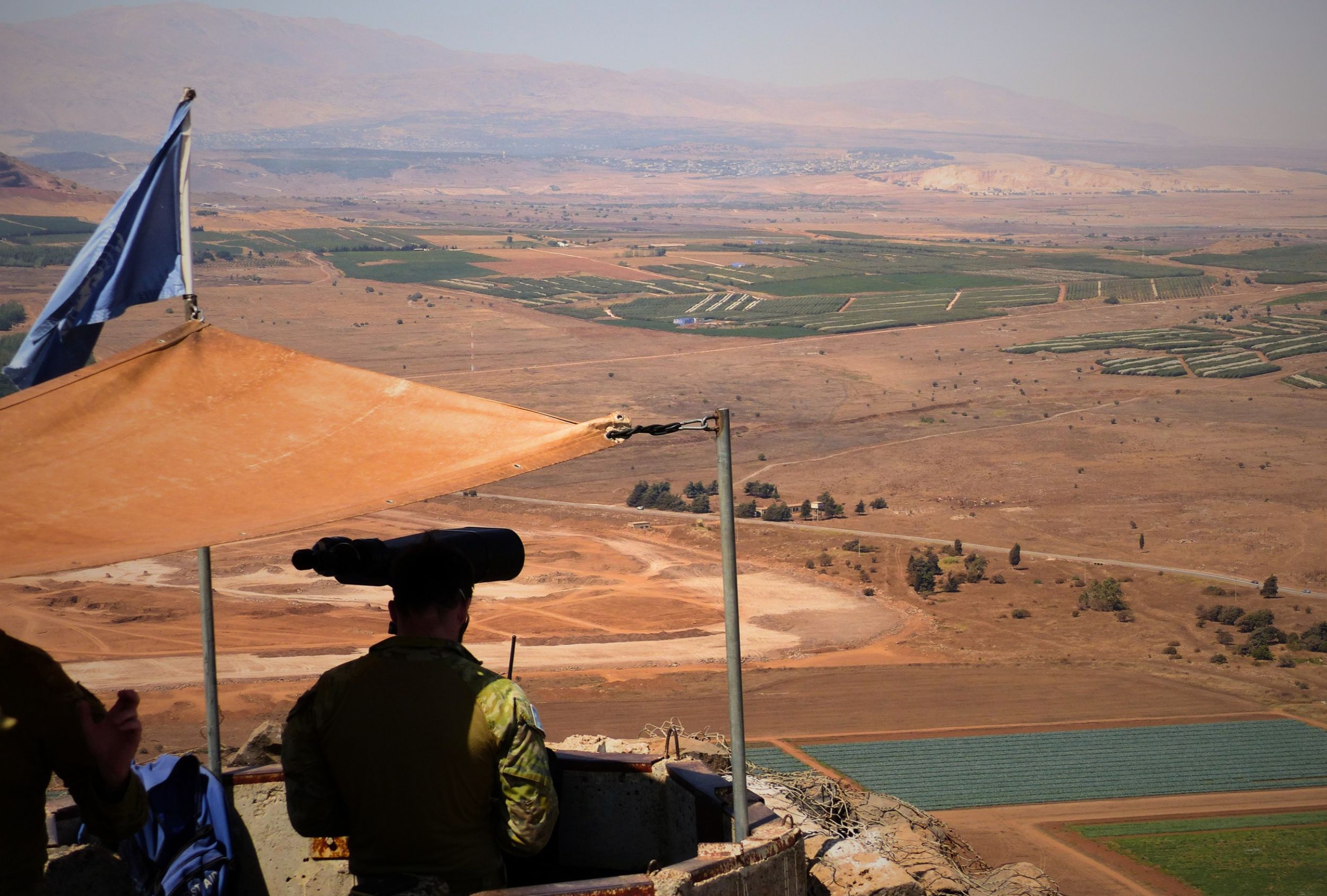
Unlike the Egyptian front, the Syrian front did not achieve a stable ceasefire, and localized skirmishes continued in the months that followed. The conflict on the Syrian front was formally brought to an end with the signing of the Israeli-Syrian Disengagement Agreement on 31 May 1974. Brokered by U.S. Secretary of State Henry Kissinger, the agreement established a UN-patrolled buffer zone and resulted in Israel returning a limited portion of the occupied territory, including the city of Quneitra, to Syrian control. The city was almost completely destroyed by Israel before its withdrawal. The disengagement agreement helped keep the Golan front relatively quiet. This situation remained largely stable for decades, until the collapse of the Ba’athist regime in December 2024. Since then, Israel has conducted near-daily incursions deep into Syrian territory, effectively disregarding the established disengagement arrangements.
Meanwhile, Egypt’s unilateral negotiations with Israel culminated in the 1978 Camp David Accords, which paved the way for the 1979 Egyptian-Israeli Peace Treaty. Under the terms of the treaty, Israel agreed to withdraw from the Sinai Peninsula.
The October War of 1973 holds enormous symbolic significance for both Syria and Egypt, as it represented an attempt to avenge the humiliating defeat of 1967. In the opening stages of the war, both countries’ armed forces managed to shock Israel and achieve significant advances, despite facing an adversary with substantial military capabilities and extensive support from the world’s leading superpower. Nevertheless, from a more critical and rational perspective, and beyond the influence of romanticized narratives and nationalist sentiment, the war can be regarded as a huge disappointment in Syria. When measured against the opportunities available, the serious mistakes made during the conflict, the heavy losses ultimately suffered, and the very limited territorial gains achieved by the end of the war make it difficult to characterize the outcome as a victory.
Following the disengagement agreement, Syrian-Israeli confrontations on the Golan front subsided, while the conflict increasingly took on a different form in Lebanon, where both sides became involved in a complex proxy conflict. This involvement was characterized by sporadic clashes, shifting alliances, and periods of indirect understandings. Both Israel and Syria supported various local factions during the Lebanese Civil War, a dynamic that continued in different forms until Israel’s withdrawal from southern Lebanon in 2000, while Syria’s military and political dominance over Lebanon persisted until 2005.
Peace Talks
In 1981, Israel announced its decision to annex the Golan Heights. The situation on the Golan front had remained relatively calm since the 1974 Disengagement Agreement, and the annexation did not alter this status quo. However, the global and regional landscape had changed significantly in the 90s. The Soviet Union collapsed, while Egypt, which had previously served as part of Syria’s strategic depth in the Arab world, had signed a peace treaty with Israel. Meanwhile, relations between Syria and the Ba’athist regime in Iraq remained strained, particularly after Syrian forces joined the U.S.-led coalition against Iraq during the Kuwait Gulf War.
These developments led the Syrian Regime to recognize that reclaiming the Golan Heights by military means would be an extremely arduous undertaking. The relative calm along the front reflected, in part, awareness of the potentially devastating costs of another war. Such a conflict would likely have been especially damaging for Syria. For Israel, too, maintaining the status quo was arguably preferable to risking any costs and uncertainties of renewed hostilities.
The peace attempts between 1991 and 2000 saw Syria and Israel embarked on complex negotiations that continued for several years and, at times, appeared to make meaningful progress. Ultimately, however, these efforts failed, largely because of Israel’s unwillingness to withdraw completely from all occupied Syrian territories.
Following intensive diplomatic efforts by U.S. Secretary of State James Baker, both Syria and Israel agreed to participate in what would become the first concrete step in a new round of peace negotiations: the 1991 Madrid Peace Conference. For some participants, the very convening of the conference represented a major achievement, as it brought the parties together for direct negotiations. However, the presence of Israeli Prime Minister Yitzhak Shamir, a radical Likud leader, posed a significant obstacle to reaching substantive progress. The conference ultimately established a framework for further negotiations.
Following Yitzhak Shamir, Yitzhak Rabin assumed office as prime minister of Israel, ushering in a new chapter in the peace negotiations—or so it seemed, at least. Rabin’s name became closely associated with the Syrian-Israeli peace process, particularly because of what came to be known as the “Rabin Deposit”: a pledge to withdraw fully from the Syrian territories occupied by Israel in 1967 and return to the lines of 4 June 1967, in exchange for peace. This was precisely the condition Syria had long demanded and that Shamir had previously rejected.
However, not everything that occurred during the Rabin era was equally positive, at least in theoretical terms. At the same time, Rabin was pursuing separate agreements with the Palestine Liberation Organization (PLO), which culminated in the Oslo Accords, and with Jordan, which led to the Wadi Araba Treaty. This approach demonstrated what could be interpreted as an Israeli strategy of “divide et impera” whereby separate agreements with individual Arab parties risked leaving Syria increasingly isolated from its regional surroundings. This isolation only reinforced Syria’s willingness to accept peace in exchange for the full recovery of its occupied territory. Yet Israel did not appear equally prepared to meet this condition.
In November 1995, Yitzhak Rabin was assassinated by Israeli right-wing extremist Yigal Amir, who opposed the peace process. The assassination underscored the strength of radical opposition from Israeli nationalists and right-wing radicals to agreements with Arab parties, including the Oslo Accords, which offered significant advantages to Israel while leaving the Palestinians with an outcome widely criticized as deeply inequitable, as well as a potential peace agreement with Syria that would only have required Israel to return the Syrian territory it had occupied in 1967.
Shimon Peres succeeded Yitzhak Rabin as prime minister following his assassination. As a member of the same party, Peres generally maintained a position on the Golan Heights similar to Rabin’s. However, Benjamin Netanyahu’s arrival in office following the 1996 elections marked a significant shift. Netanyahu adopted a much more radical position on the Golan Heights, rejecting any withdrawal from the territory or commitment to the “Rabin Deposit.” There were later reports of a secret channel of communication with Syria, facilitated by American businessman Ronald Lauder. However, these efforts ultimately failed to produce any tangible results.
Following Netanyahu, Ehud Barak assumed office as prime minister of Israel. During his tenure, negotiations returned to issues that Netanyahu had previously rejected. The negotiations under Barak can be summarized as follows:
- Syria’s position: Syria continued to adhere to the “Rabin Deposit,” insisting on a commitment to full Israeli withdrawal to the lines of 4 June 1967. This boundary would give Syria direct access to the northeastern shore of Lake Tiberias (the Sea of Galilee), as well as a share of the lake’s waters and access to the Jordan River.
- Barak’s position: Although Barak acknowledged the existence of the “Rabin Deposit,” he refused to define the border according to the 4 June 1967 lines. Instead, he proposed border adjustments that would require Syria to relinquish territory along the northeastern shore of Lake Tiberias, thereby ensuring that the lake and its surrounding waters remained entirely under Israeli sovereignty.
Damascus refused to concede the northeastern shore of Lake Tiberias, maintaining that the territory was Syrian and insisting that Israel commit to a full and comprehensive withdrawal from all occupied Syrian lands. Following a meeting in Geneva between Syrian President Hafez al-Assad and U.S. President Bill Clinton, the long-running Syrian-Israeli negotiations effectively came to an end. The talks collapsed because Israel was unwilling to return all the occupied Syrian territory. From the Syrian perspective, Israel appeared more interested in prolonging the negotiations than in reaching a genuine and just peace.