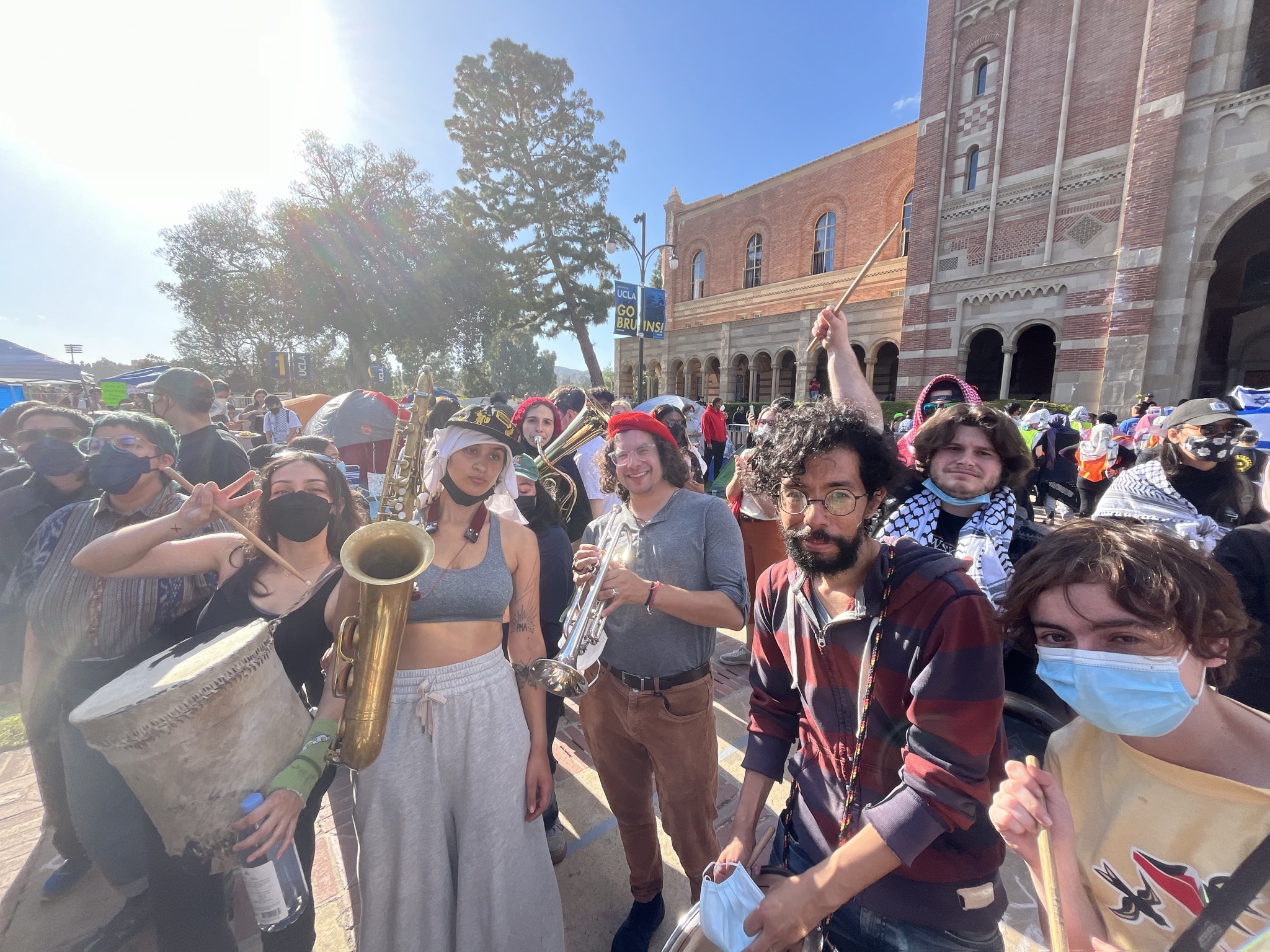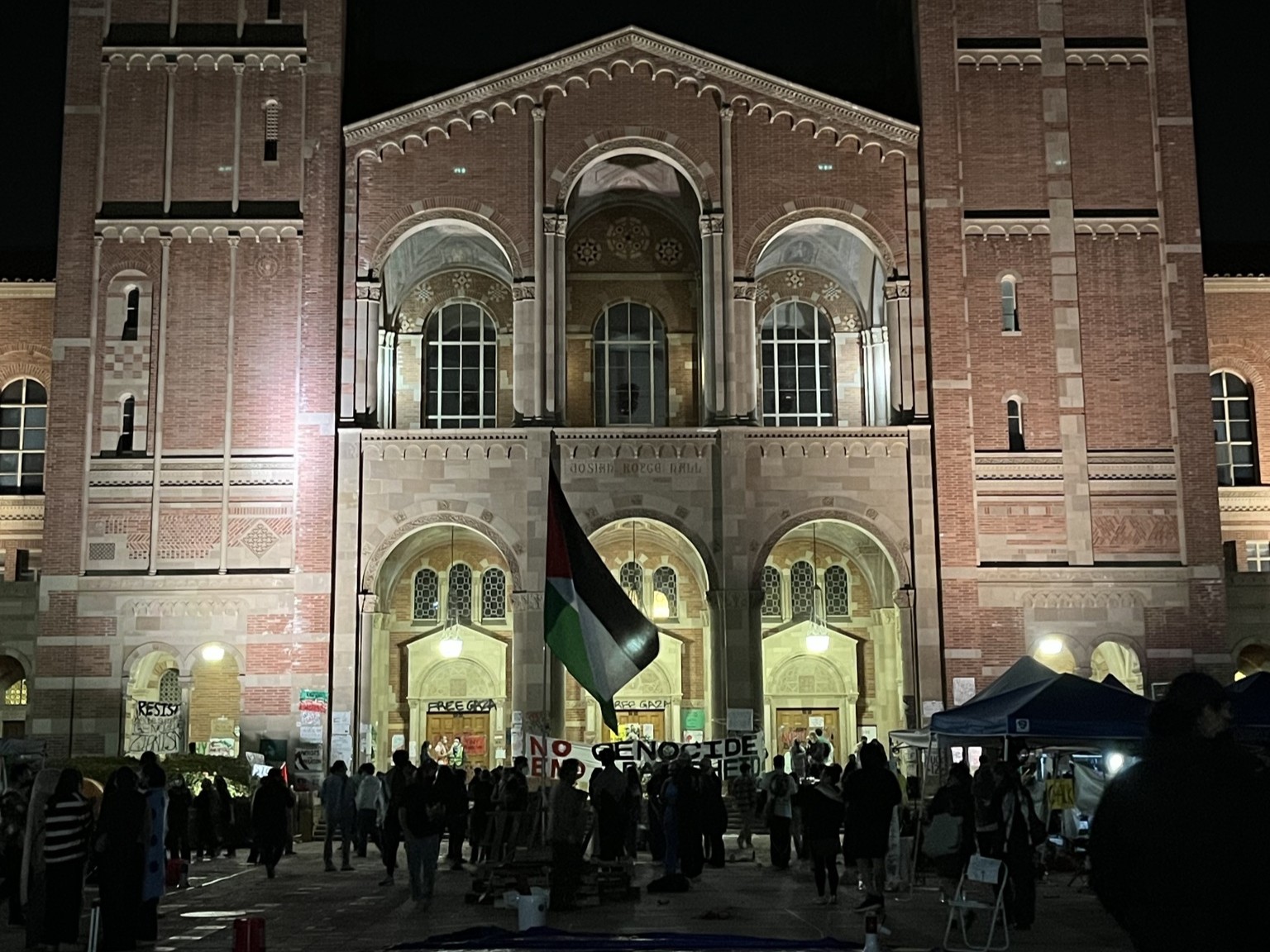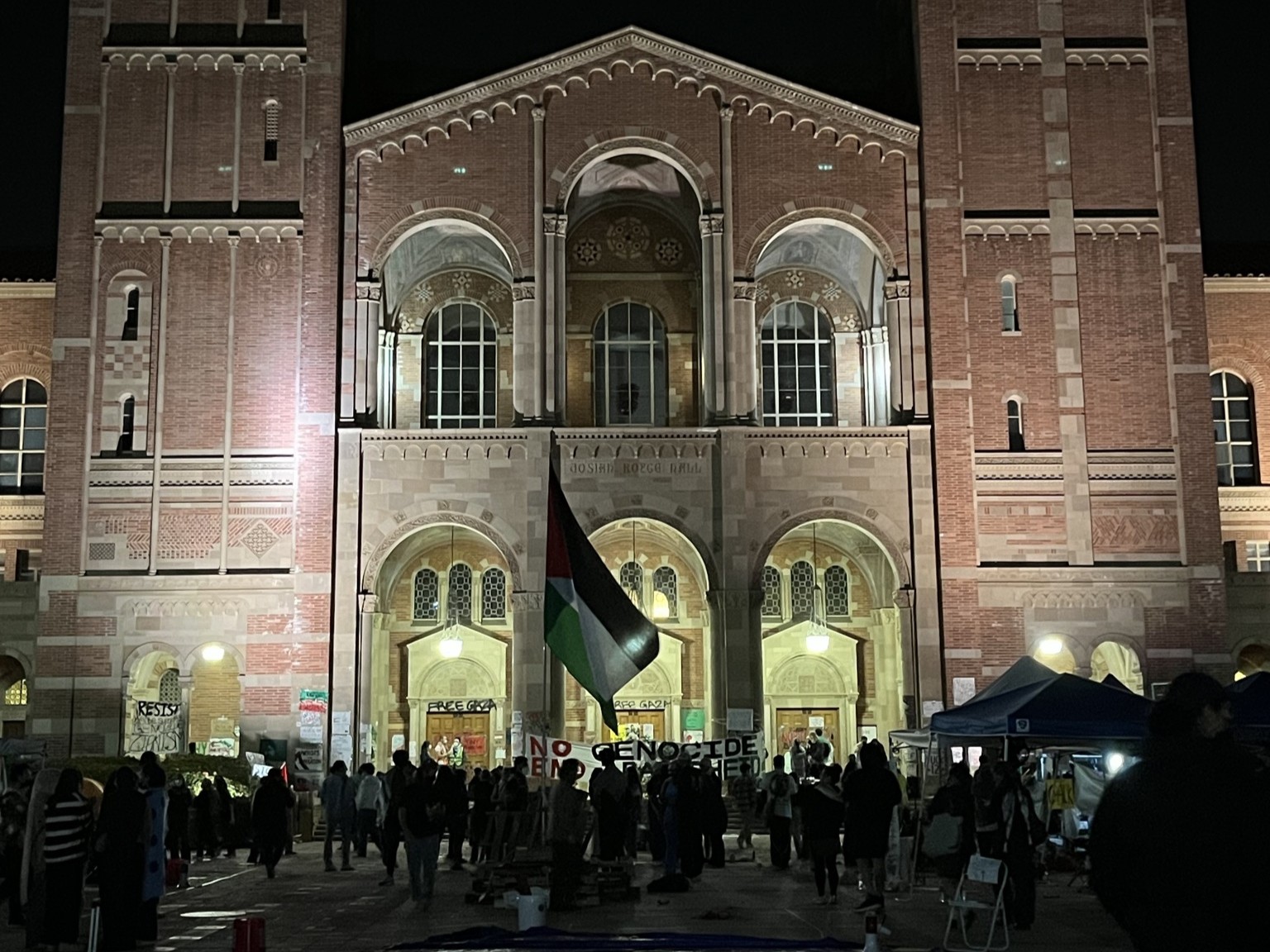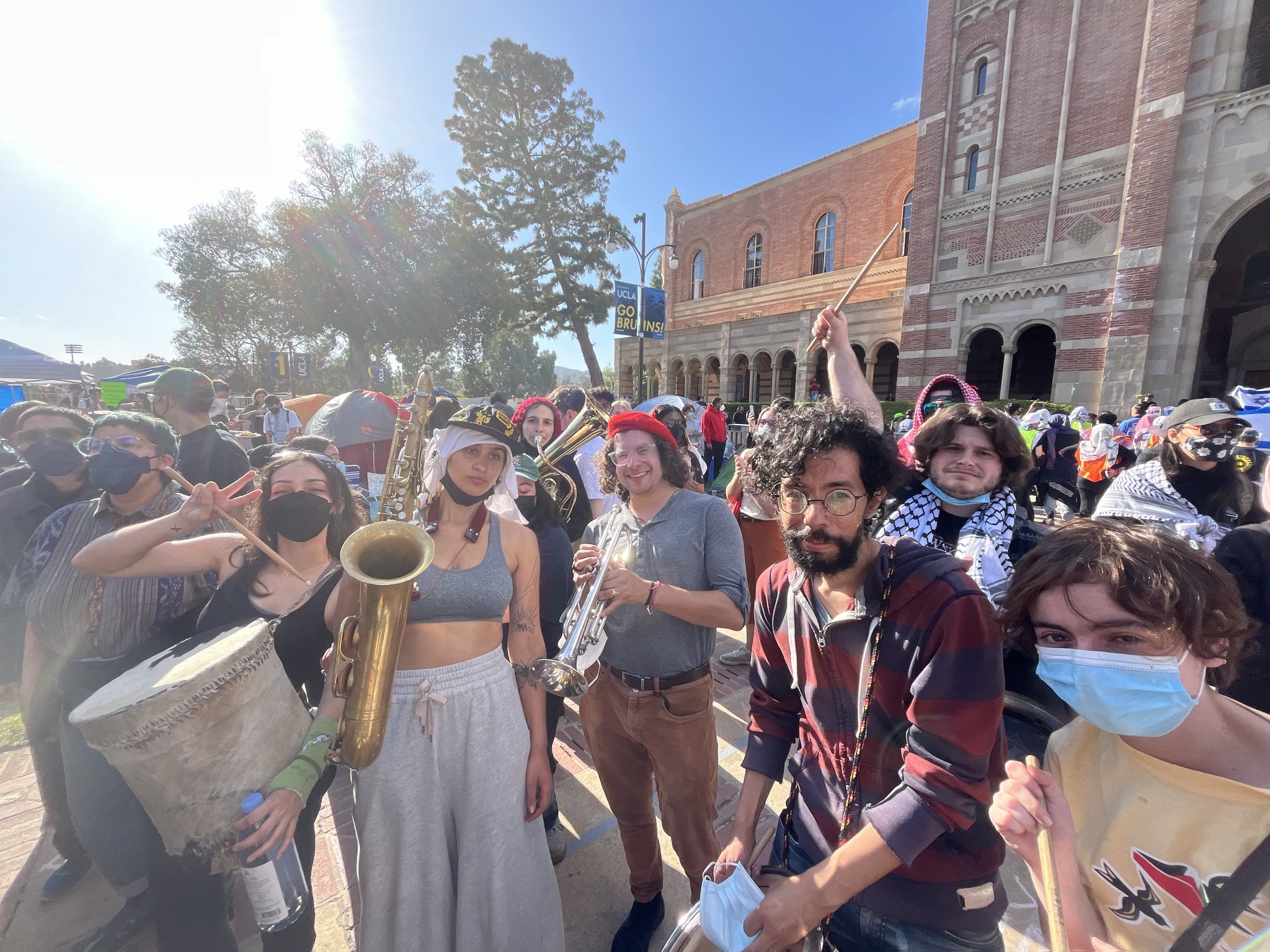
For three years students all over the world have been fighting their universities to divest from the genocide in Palestine. On the 3rd of October, Elisabeth Koch interviewed Galo Lopez, a PhD candidate in History and graduate student worker at University of California Los Angeles (UCLA) about the Student Intifada, the repression he and his colleagues are experiencing in the US, and their lessons of resistance against genocide and capitalism. In Part 2 he describes his trial and broader strategic considerations.
In Part 1, Galo describes the beginning of the student movement in 2023 until his arrest.
english|deutsch
etos.media: What consequences were you facing after your arrest? Was everything resolved?
Galo: We thought being arrested was the end of it. We thought all we had to work on was getting our charges dropped on the municipal level. Because these were cops under the jurisdiction of the city we had received citations fom the city. However, the university administration was trying to pin me and others with violations of the Student Code of Conduct. For me that was “Obstruction and Disruption”, “Disorderly Behavior”, “Disturbing the Peace” and “Failure to Comply”, all of which have been deemed with insufficient evidence by the panelists – twice! The university pretends to be a court system in these cases, but they do not observe any legal processes.
This is how it worked for me:
In the following Fall quarter of 2024 (etos: UCLA is on a quarter system, so fall would be the next full-time quarter after spring), we had to start the interview process, in which we had to tell the administration that we don’t plead guilty to these charges. Then in the Winter and Spring quarters 2025 the university set the hearings. I was supposed to have my hearing around April 2025, but I was not able to make their hearing because I had a class conflict, so we had to reschedule. And that took months, until the next Fall quarter. But now I was teaching again, and I wouldn’t skip teaching my students for this stupid hearing. I have to teach! So they pushed it to January 2026. By then my second lawyer, whom I hired after my first lawyer got married and went on her honeymoon, had to reschedule for bereavement. So we pushed the hearing to April 17th 2026.
That week was crazy: I had to defend my prospectus, I had to accept the offers for my social work program that I applied for in case UCLA would expel me. And I needed to do my taxes… [laughs] that one was on me. But the prospectus defense; I was pressured to do it, just as I was pressured to become a doctoral candidate before the original hearing appointment. If they had suspended me before advancing to candidacy, I would have had to re-apply to my program in the fall and had to be re-admitted the fall after that, which would have put my academic career on hold for at least two years, longer if the suspension period exceeded three academic quarters.
That is the difference in suspensions for graduate students from undergrads. Undergrads, after their suspension end, can return and finish their curriculum, while grad students get kicked out of the program immediately. And there is no guarantee to be re-admitted. Some of my colleagues tried to negotiate with their department and their department said: “We don’t want you back.” Effectively it is an expulsion not a suspension. Graduate students are then stripped not just of their student status, they are stripped of their employment, their funding, their health care, their childcare, their housing; you become estranged from the academic community and separated from your research. My colleague Seth, whom that has happened to,…some of the people in his department literally called him a “stranger” to his face. The grad student loses everything, so I am fighting for the status not to be stripped away from me.
At the hearing, there are panelists as “the jury”—made up of trained faculty, alumni, staff—the university as “the people”, and the defendant. No students.
After the panelists introduced the case, the Office for the Student Code of Conduct gave their case and after they had been interrogated by the panelists, it goes to the cops. Then witnesses were interviewed and I could give my statement.
In my case, one of the cops— you can’t make that shit up!—was the prosecutor of the OJ Simpson trial. That cop was speaking as if he was on site when I was arrested, even though he had not beenthere. Importantly, in that statement he also referenced videos of the arrest. Long story short: the panelists sided with me and acquitted me of the charges and stated that no videos were submitted, because the cops had missed the 72-hour deadline.
In a fair trial that would have been the end of it. But because this is not a fair trial, the Dean has veto powers. And the Dean vetoed cases of some of my friends as well. So, of course, he vetoed mine, too, and decided to reopen the case for a “procedural error” to bring in the video evidence and I had to come back a few days ago. This last appeals process was also problematic because the Dean mislabeled his response to me and wanted to reopen the entire hearing two weeks ago. Regardless, on October 1st the panelists had declared “insufficient evidence” the second time. We made sure we had the same panelists as in the first hearing, which is not always guaranteed. We are awaiting the Dean’s veto decision as we speak. If he vetoes, we will sue the university. (etos: A few days after the interview, Galo won his case against the university and is not facing suspension/expulsion anymore).
etos.media: For you as a graduate student, this instance of police violence happened at your workplace. How did your labor union, but also your students and supervisors react to the violent repression you are experiencing?
Galo: We were really lucky that our union president was present when the first encampment was raided so violently. So everybody was uniting in solidarity against the brutal force of the university administration. That made it possible that the union bureaucracy called for a strike vote over workplace misconduct. But it was a very politically oriented strike, a pro-Palestinian strike, very different from the contract strike in 2022. It wasn’t just about our salaries but about our identity outside of work because it included a divestment demand. And Cops off Campus was finally on the table again—after the betrayal in 2022. (etos: the demand of the student movement to abolish the university police department was translated into a contract demant in 2022, which was quickly wholly abandoned by the bargaining team.)
For my history department and especially my adviser, Robin Kelley, who is an eminent scholar of racial capitalism and abolition, we have to practice what we preach. As Professor Kelley stated publicly: this is not only a win for me as a student, but for the entire movement. It needs to be done!
As for the other students, they were on my side. But it got hard. You could see our numbers dwindle with every encampment. We felt very strong when we were first attacked by outsiders, but when the police came in, we felt weak. You can only do so much with a notebook and a backpack. We still were many people, but it wasn’t as grand as the first encampment. At first we thought these attackers were our enemy, but we quickly found out it was actually UCPD, the prison-industrial complex of UCLA, against the students, the workers and our departments. And that lowered morale.
The union, however, fucked up: when the current contract was negotiated, they took out divestment and Cops off Campus again! It was really sad to hear that.
(etos: university students and workers have since published a white paper detailing UCLA’s ties to Israel, which puts divestment in focus again.)
etos.media: I would like to take a look at the broader political context as well. While the genocide escalated in 2024, Donald Trump was inaugurated for his second term. What impact did that have on the Palestinian liberation movement, especially the students? Which changes in political support did you notice during Trump’s second term?
Galo: It absolutely had an impact. Especially at a public university where the majority of the funding comes from the state and federal involvement. The Trump administration had expressly stated that those who had participated in the student protests must face consequences and threatened to defund any university that would not follow this order. He completely dismantled the Department of Education in order to target students. We perceive this to be one of the reasons why the Dean was so adamant about suspending students: both Zionist private donors as well as the Trump administration were trying to end the student protests. AIPAC has its fingers everywhere. At UCLA we thought we had to deal with the university administration, but actually we had to face the Trump administration. And I see the same at Columbia now. That’s the reason, why I can learn so much here. Columbia has told me that this is a much bigger entity than we thought. We deal with the fascist-capitalist regime, whose current face is Donald Trump.
etos.media: Both the German state and the US seem to have used the escalating tension around Palestinian liberation to justify increased public surveillance and police brutality. What impact did that have on the pro-Palestinian student movement in the US?
Galo: The Student Intifada has exposed the surveillance state, which has always been there in the US university system. Yet there are still plenty of SJPs (Students for Justice in Palestine) around the world protesting—miraculously. I just came back from watching the documentary on Edward Said a couple of days ago, where I met his daughter Najla Said. She told me if her father was here, he would be so proud of the students. He would be disgusted by the administration and so proud of the students. The students will always be the core of the universities. They might be run by the administration, but the students are the core. Think of it like the seed of a shiny apple. The fruit might be shiny and tasty, but it is the students that will create new universities.
etos.media: In the past three years, which successes do you see for the student movement? How would you like to change the current strategy?
Galo: We are still in the midst of a great student insurgency. Morale might have dwindled, but the consciousness remains. When we are using the accurate descriptors of genocide, fascism, capitalism, we are engraining in our minds the consciousness that we need to build to change these systems of oppression. Right now we are dealing in a world of epistemologic violence, in which students are denied their right to education. Even using the word “Palestine” was not a given before. Yet you cannot learn in an institution where the voice is only one-sided and completely surveilled. In this sense, simply using the word “genocide” in a public context, hearing even celebrities use it, is a success.
The language of the Intifada has bloomed across the globe. People are now in debate with each other, when before they regarded the Holocaust as the only genocide. But that had been incorrect even before 2023. The first genocide was perpetrated by the Germans against the Ovaherero and the Nama in what is today called Namibia. So the Palestinian liberation movement made it possible to talk at scale about colonial violence.
Abolition is also a much bigger issue again. People are rallying to abolish ICE! All these topics are presented in the media again. And this is the only thing I will give to Trump: Thank you, for being an idiot and an asshole—because you have allowed us to see the violence and the oppression that we encounter under this system.
But now we have the language to continue. It is no longer epistemological violence, but epistemological progression.
Look, we have a Muslim mayor in New York City! Well, personally, I hate all politicians. I don’t believe any change can be made within the capitalist system, but Mamdani, even though he is still a politician, was at least partially assisting the Student Intifada, when he threatened to sue Columbia, for example.
As for changes: I woud like to see student workers unions become more active. They need to remember that we will always be students first, instead of separating the spheres. We must protect our students at all costs, because systemic violence and racial motives are detrimentally affecting all of us.
Unfortunately, I saw that also in organizing outside of the union, where graduates and undergraduates butted heads. In my opinion, our job is to support the undergrads and encourage them, not to assume we are superior because we are their teachers. Status means nothing when we are all oppressed.
In the broader movement, I would also like to see an appreciation of music, a more artistic and expressive stance; music has allowed us to see the magnificence of collectivity and community. It is what resonates. People should start listening to Palestinian music. They should start listening to music of what they deemed the enemy, because they are not the enemy, they are artists.
Obviously, I want to see prisons being abolished, ICE being abolished, the binary government being abolished. Stop saying: I am in DSA (etos: Democratic Socialists of America, by whom Mamdani was backed), but I am running as a Democrat. Stop it! Just be direct! There is no such thing as passive progression.
etos.media: German students are also still fighting their universities‘ complicity in the genocide. Some have democratically voted for BDS resolutions within their student bodies despite hostility from university leadership and Zionist legacy media. Do you have any words of encouragement for them?
Galo: The streets are our classroom and they will be until the day we die. You are bringing school back to the people: freely spoken, freely learned, freely taught. Keep moving forward in bringing education to the streets. Teachers are nothing without their students. As long as you continue the fight, we will be your teachers, while in this moment, we are also humbled to be your students. Continue saying “Free Palestine” because a free Palestine will free us all.